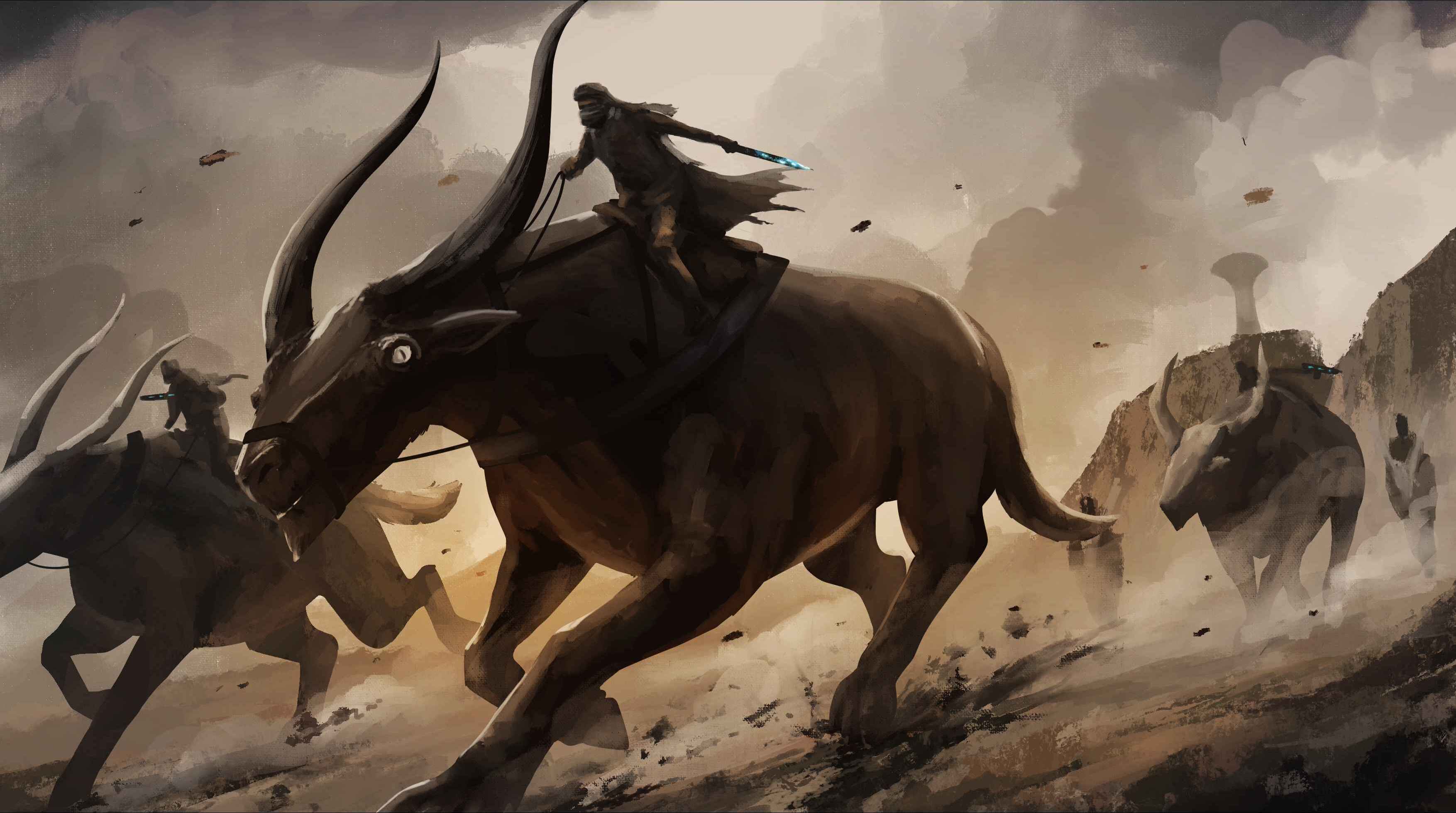
Geban
People of the Geba continent
Physiology
The average Geban male stands at approximately 5'8". The average female at approximately 5'3". Hair ranges from light brown to dark brown. Skin ranges from copper to darker pale, with women notably lighter in complexion. Following the Era of Imperial Conquest, the average skin tone across the continent darkened as populations from conquered territories migrated inward and mixed with the existing population.
Physical variation among Gebans is wider than in any other single ethnic group on the planet. The five nations that existed before unification were genetically distinct populations absorbed into a single identity over thousands of years. The nations no longer exist and their names survive only as historical curiosities, but their bloodlines persist in every generation. A Geban who stands over seven feet tall and carries a frame built for sustained heavy labor is expressing Varenan ancestry. Varenan descendants can reach as tall as 7'7" for males and 6'8" for females, making them larger than the average members of most other populations on the planet despite being ethnically Geban. A Geban who is lean, muscular, and fights with an economy of movement is expressing Garnath or Beithon lineage. A Geban woman who is notably taller than every man in her district, with orange-brown hair and an obsessive interest in financial systems, is almost certainly carrying Thaloryn markers. A Geban who is pale with dark hair and grey eyes and moves between communities without forming lasting attachments is carrying Therik ancestry.
Psychology
Gebans are structuralists. They build systems and they enforce them. They believe in hierarchy because it produced results for six thousand years, and they cannot conceive of a world that does not require one. They speak in elevated, formal patterns regardless of class; a Geban laborer speaks with the same grammatical structure as a Geban politician. The pattern is cultural. The language itself was standardized during the formation of the Empire and has been reinforced through every generation since.
The defining psychological trait of the Geban population is extreme compartmentalization. Due to their history of conquest, loss, expansion, and the cultural expectation that function continues regardless of circumstance, Gebans developed the ability to fully inhabit one emotional state, seal it completely, enter another, and return to the first on a whim with no transition between them. A Geban can lose a loved one, attend a festival the same evening with genuine enjoyment, and return to grief afterward as if they had never left it. Both states are real and fully experienced, and the ability to move between them without one contaminating the other is what makes outsiders misread them. The most visible expression of this is their facial behavior: a stoic, serious, sometimes hostile appearance that shifts instantly into a full, warm smile and then shifts back just as abruptly. This is the same compartmentalization operating at the surface, and the transition is so sudden that other populations frequently interpret it as instability.
Views
Gebans view other populations through the lens of what those people do for the world the Gebans believe they own. They respect the Ngorrhali for their size, their history, and their role in the Empire's military foundations. They view the Yuvaari as fighters and athletes. They view the Thazvaari with a complicated mixture of historical resentment and economic dependence. They view the Jeyrhan as essential and brilliant, but they will never say it with the same weight they give their own accomplishments. They view the Berinese as loyal. They view the Kelan as useful. Their greatest strength and their greatest weakness is the same thing: they believe they are the center of everything. This belief drove them to unify a continent, conquer or assimilate every foreign population they encountered, build the relay network, standardize the language, establish the currency, and create the systems that 71 billion people depend on to survive. It also makes them incapable of seeing past themselves.
Modern Era
The Geba continent operates as a capitalist society with clear wealth classes. Over thirty percent of the population lives near the capital mega hub of Karesh. The gender ratio on the Geba continent specifically is approximately 5:1 to 8:1, significantly lower than the planetary ratio of 25:1. Males are more present on the origin continent than anywhere else on the planet, though they are still vastly outnumbered. Women dominate most professional and domestic functions. Polygamy is accepted but not encouraged. Most households function around the practical reality that there are not enough men to sustain monogamous structures at scale. There is no meaningful distinction between the terms Geban and Imperial. The political identity absorbed the ethnic one so completely over six thousand years that the two are synonymous.