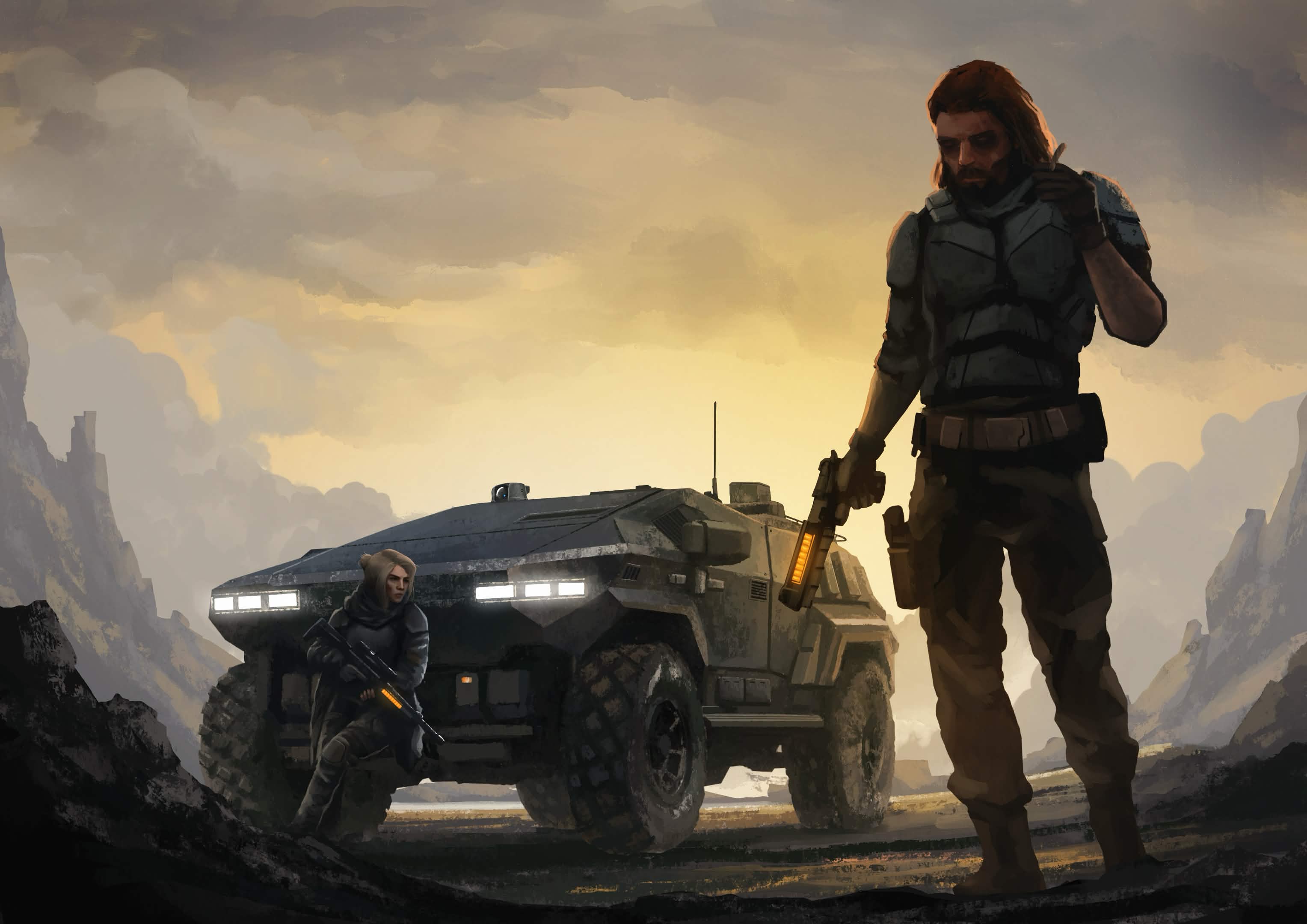
Huyasa Sers
Researcher and Illustrator
Overview
Huyasa Sers was a Yuvaari woman raised on Jeyrha who co-led the first comprehensive flora and fauna survey across Geba during the Era of Imperial Conquest, at the height of the Geban-Thazvaari War. She was the expedition's illustrator and primary field observer, responsible for drawing the creatures they encountered. The whole team worked closely with the fauna, but Sers went further. Where her colleagues observed a creature from a position that allowed documentation, she placed herself close enough to watch it in active motion, a predator mid-hunt, so she could capture every movement instead of drawing it at rest. She got close to animals while they were doing the things that made them dangerous, because she believed an illustration of a creature standing still showed only a shape. Her partner Kazo Reyjuul documented these encounters with increasing alarm, in field notes that swung between admiration and the certainty that Sers would not survive the expedition.
Expedition
The team numbered 52 and included Gebans, Jeyrhans, and Berinese. They departed from Jeyrha and crossed to the Geba continent, then traveled through Ngorrhal, Kela, Ukhaalstaag, Coastal Thazvaar, Yuvaar, and finally Manalheim, cataloging keystone species for settlement planning, supply assessment, and withdrawal protocols. With the war at its height, they moved through regions where active naval conflict, Thazvaari resistance, and the creatures themselves could all kill them.
Fauna Encounters
Sers drew the Greater Smilohound packs of Ngorrhal from within visual range of their territorial perimeters, close enough that her colleagues refused to follow. The team avoided the ice bear territories of the Ngorrhali passes entirely after finding territorial markings that the Frost Sentinels among their escorts identified as belonging to mature specimens. In Kela they encountered Gelivox Stalkers that followed them for days before attacking, and Hollowwing Bats that struck during night camps. In Ukhaalstaag the terrain killed members of the party before any creature could, and the sheer cliffs reduced the team before they reached the coast.
Yuvaar
When the expedition reached Yuvaar, several members of the team chose to stay and never returned. The island offered something the rest of the route had not: a place where the relationship between humans and dangerous fauna was spiritual, and where the creatures were hunted with bare hands under a framework that treated the encounter as harmony. Sers was Yuvaari by blood but had never set foot on Yuvaar, and the stop was the first time she had seen the culture her ethnicity came from. Her illustrations of Goldenwing raptors and Yuvaar Kelek from this period carry a quality her other work does not.
On Manalheim they documented the Emberjaw Sentinel in its volcanic habitat. Sers drew the creature lounging in geothermal vents from a position Reyjuul described as suicidal, close enough to see the texture of its ember-hued jaw plating while the volcanic terrain shifted beneath her, and those illustrations remained the most detailed visual record of the species for centuries afterward.
Thazvaari Conflict
Field relations with Thazvaari researchers they met along the route collapsed over ownership disputes and wartime enmity, ending in an attempted assassination and a retaliatory seizure of data. In the Manalheim volcanic ridges a Thazvaari infiltration ambush struck the party, and the Geban researchers in the team picked up arrays and suppressed the advance with a discipline that left Sers and Reyjuul stunned. These were people who had spent the previous three months counting petals and measuring soil samples.
The Geban-Thazvaari War defined the era those researchers had grown up in. It had been formally declared by Emperor Vaer'Terund Venar and was still consuming the Empire's attention and resources when the expedition departed. It was normal for Geban children to grow up learning weapon systems, anti-boarding procedures, how to read unfamiliar signals, basic formations under sudden fire, and common Thazvaari phrases the same way they learned to read and count. By the time a Geban reached the academies it was assumed that any expedition beyond relay coverage would encounter the war, and while avoidance was always the objective, every member was prepared to survive contact and fight their way out if avoidance failed. The only civilian population on the planet with comparable readiness was the Ngorrhali engineers, who worked in contested passes where construction crews and combat units had never been separate. Reyjuul wrote afterward that watching the scholars fight made him wonder what they were choosing not to become by staying in the academies, and what the actual war-fighters must be like.
Manalheim
Manalheim was neutral and mostly unknown during this era, and the Thazvaari Dominion was the only other nation sending researchers to the continent. The Geban researchers who survived the route chose to remain on Manalheim, established the first imperial outpost there, and halted any further Thazvaari research efforts in the region. Sers and Reyjuul did not stay.
Legacy
Of the original 52, 31 died to a combination of terrain, fauna encounters, and Thazvaari attacks. Sers and Reyjuul were the only two members to return to Jeyrha with the complete records. The expedition's codex reshaped imperial practice with route discipline, modular outpost design, and resource-frontier classification systems that remained in use long after the war ended, and the illustrations Sers produced remain the foundational visual reference for dozens of species in the codex.