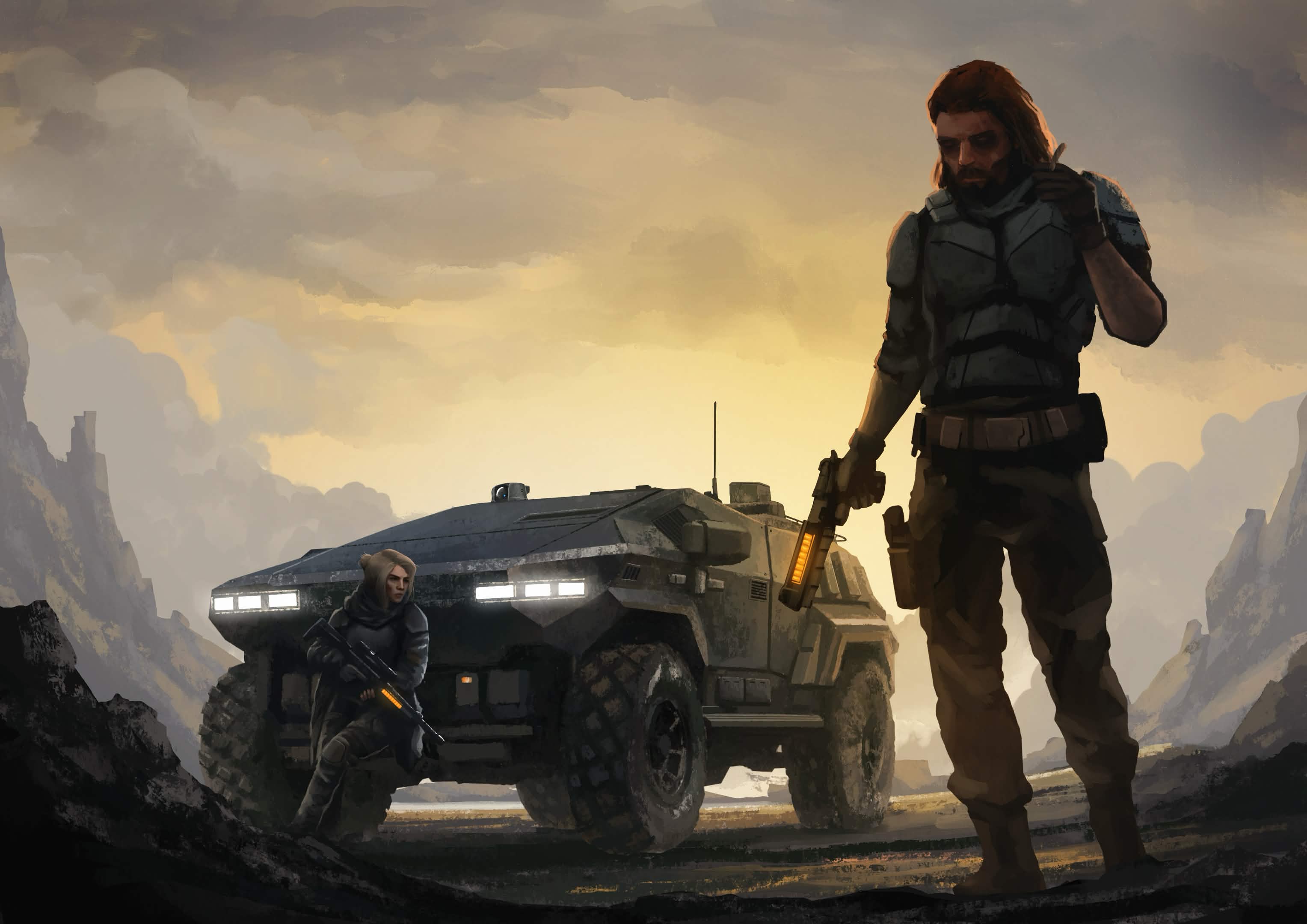
Planet Geba
The Failed Star, the Parent of Children
Geba is a brown dwarf, a body that gathered enough mass to compress its core but never crossed into sustained fusion: a failed star turned into a world. Its radius of 88,971 km gives it a surface of roughly 99.5 billion square kilometers, of which the eleven inhabited continents together account for less than a tenth, while the Uncharted alone covers more than seventy percent. The conditions that made any of it survivable were engineered by the Velcrith over an unknown span, long before biological life ever touched the surface.
Three Child stars orbit it in a stabilized braid, and nearly everything about daily life on Geba follows from them. There is no global day and night. Light here is regional and geometric, decided by where a place sits beneath the three shifting paths, which is why two regions at the same hour can stand in searing brightness and dim cold at once. The relay network is the only reason a civilization of seventy-one billion, spread across these distances, functions at all.
An unmodified brown dwarf of this size would crush anything alive under gravity dozens of times past what a body can survive. The Velcrith restructured the interior, converting the dense core into graduated density shells and pushing mass outward, lowering surface gravity without shrinking the world. The three Child stars help hold it to a livable weight: their combined tidal pull draws outward on the upper layers in a pattern that shifts as they move, so gravity is not even uniform, running lighter on coasts and low ground than in the deep continental interiors.
The result is elevated but survivable, and every population on Geba carries denser bone, thicker muscle, and more efficient hearts than a gentler world would ever demand, with the Ngorrhali of the stratospheric passes at the far end of that adaptation.
Izhara, white-blue and closest, drives the 32-hour day and the storm systems. Zhaerys, orange-red and slower, steadies the seasons, and where its plane overlaps Izhara's the doubled light scorches the ground beneath. Saethern, silver and fixed above the south pole, never sets in the far south and sinks toward the horizon as you travel north until it vanishes entirely.
Some regions live in perpetual twilight, others cycle through overlapping colors as different stars pass overhead, and every continent in this codex carries an illumination as distinct as its climate. It is why the continents below run from the scorching deep inland to the frozen 60-below reach of Ukhaalstaag, each one set less by latitude than by which stars stand over it.
The Geba continent, the center of civilization for six thousand years, is the smallest inhabited landmass at about fourteen million square kilometers, while the single Thazvaar mass, the largest inhabited continent, runs near five billion. The Uncharted dwarfs them all at over seventy-two billion. The highest surveyed peak reaches approximately 48 km in Ngorrhal, though the mountains of the Uncharted exceed 60 km and are the tallest on the planet. The oceans average past sixty kilometers deep, and the deepest surveyed trenches fall beyond three hundred, far past the reach of any technology that exists.
Every human line on Geba, Geban, Thazvaari, Yuvaari, Ngorrhali, Jeyrhan, Berinese, Kelan, Ukhaal Walker, and Neron, is a product of regional adaptation to Geba's extremes. Its fauna runs from the goldenwings of Yuvaar to the titanbirds and the burrowing behemoths, and its flora grows toward the planet's shifting light in forms found on no other world, because there is no other world quite like this one. Choose a continent above to begin.
Geba
The Imperial Heartland
Geba is the origin continent and the smallest inhabited landmass on the planet, and for six thousand years it has been the center of everything. Vaer'karesh welded the five nations that once divided it into the first empire, forcing one language and one identity by conquest, and though those nations are gone their bloodlines still run in every generation. The capital of Karesh was raised by Empress Vaer'yinda on ground she purged of all life as a gift to her father, and the imperial day itself begins and ends when Izhara passes over the continent.
It runs as a capitalist society with visible wealth classes and the strictest laws on the planet, though enforcement has limits the relay never shows. No syndicate operates openly here, yet the Jerhit Syndicate has threaded itself into the legitimate economy through constructed identities, and trafficking supply chains reach into the capital itself. Geba is where everyone with no further path but a will to earn comes: veterans, expedition mercenaries, Yuvaari hunters, Ngorrhali fighters, all converging on Karesh to make the most varens possible or to train the next generation of contractors.
The Rite House of He Who Allows is the official faith of the capital and the source of most planetary law, followed by billions here by default even though Veyan Thought is what most actually believe. Geba holds the largest Engineered population on the planet, around 320 million, living openly among natural-borns in the hubs and markets.
It is also the heart of the centralization question. The organized reformist movement is four-fifths imperial Geban, the people who most remember what a center felt like, even as the continent profits more than any other from the decentralized world it says it misses. A citizen can build a life here without turning to corruption, but it takes a rare kind of person to do it.
Kareshthe capital, and the center of the planet
Karesh is the gravitational center of Geba and, by extension, of the world. More than three in ten of the continent's people live within reach of its mega hub, imperial time is measured from it, and it enforces the strictest laws anywhere. It is the city everyone with nowhere left to climb comes to climb anyway, where Yuvaari hunters, Ngorrhali fighters, combat medics, and airship pilots all arrive to train the next generation and take the largest contracts the registry offers.
It carries the largest Engineered population on the planet, and it is normal to see them in the relay hubs and residential districts. The center of advanced medicine moved here from Jeyrha long ago, not because Karesh was more capable but because it simply had far more people who needed it.
Thalorynthe ruin that was never rebuilt
Thaloryn was the ancient financial power among the five nations and the first to ally with Vaer'karesh, and it sits half in ruins to this day, deliberately never rebuilt so the wars that forged the Empire could not be forgotten. It remains the global center of art and ethics, a role it inherited after the destruction of Midreach Lira.
The Thaloryn Wanderer, a figure out of pre-imperial folklore, is said to haunt its broken structures, and the old story has taken on a darker weight in the modern era as criminal groups adopt the Wanderer's likeness before carrying out violence.
Therikthe port everyone leaves through
Therik is the southern port, built around the continent's second mega relay, and it carries a staggering eight percent of all air and sea traffic on the planet. It descends from the hated nomad-trafficker nation of Therik, who joined the Empire last and only because its infrastructure let them leave the continent more easily. The nation that wanted nothing but to leave became the place everyone leaves through, working and transient and never still.
Varenaeverything that is not a city
Varena is the countryside, the whole rural body of the continent. If you are not near a hub, you are in Varena. It is the founding nation of builders and farmers who held the most land and the most people and never wanted a capital, and it was their descendants who raised the relay network and the capital itself. Southern Geba, part of Varena, holds more Jeyrhans than Gebans, drawn up from the south long before the Empire ever reached Jeyrha.
Midreach Lirathe martyred sacred state
Midreach Lira was the state built by Princess Lira, the first Seraveth Vessel of the imperial line, under separate governance because the centralized system was never enough for what she wanted: a place where the law served the population rather than the bloodline. The Church of the Infinite Maw destroyed it at the very onset of the Infinite Maw Conflict. It stands rebuilt now under the Church, a black spire marking the old capital, the single act that began the war.
Coastal Thazvaar
New Geba
Coastal Thazvaar is the fully integrated southern coast of the former Thazvaari Dominion, once the naval and technological heart of that power, conquered after decades of war and assimilated so completely that hardline imperials call it New Geba. There is no ethnic or linguistic divide left. Thazvaari as a language was absorbed into imperial, children play in mixed communities, and the line between Geban and Thazvaari identity has dissolved into something that belongs to neither and both. The coast is also home to the vehicle guilds responsible for researching thermal cells and pushing airship and rover systems to their absolute limits in terms of speed, making Coastal Thazvaar the center of high-performance vehicle development on the planet.
The Dominion's rail and water systems were the most advanced on the planet at conquest, moving people and goods at speeds still hard to match while carrying hydropower and irrigation along the same routes, and the Empire adopted them everywhere. This is the only safe road into Inland Thazvaar that does not cross the Berinu Islands or circle the planet, and it holds some of the most luxurious cities on Geba beside some of its poorest slums, a pressure that produces artists and athletes trying to escape poverty without joining the inland syndicates.
Culture here is the merged Geban-Thazvaari identity at full volume: the Scarlet Verse, women-led festivals of ritual and endurance, and the Thazvaari Ascension, a vertical combat sport descended from Dominion boarding drills, both alive in the streets and drawing constant crowds.
Politically the wealthy are firmly against centralization, since redistribution would end the life they have built and they have the resources to make that opposition effective. Beneath the opulence the criminal economy never stops; Vinscel documented open daylight auctions of drugged captives in the Gulf's luxury districts, hundreds walking past without a question.
Kharan's Gulfthe largest city on the planet
Kharan's Gulf is named for Kharan Khatan, the most feared pirate warlord of pre-relay Geba, who fortified the inlet as a last stand against the Dominion. It was the site of the final siege of the Geban-Thazvaari War, where Emperor Venar'Tal Kareth executed King Hies and took Queen Nethelys as his wife.
Today it is an enclave of ultra-luxury for the planet's wealthiest, glass and stone and gold stacked down through every tier to the poorest. It is the single largest city on Geba, and it holds wealth and rot on the same coastline: high-stakes crime and political maneuvering run openly beneath the opulence, in daylight, with no one asking.
Auren's Tributarythe city that held
Auren's Tributary is an ancient imperial coastal city near Thazahd that had never fallen, until a full warlord coalition launched an omnidirectional assault, striking from outside and within at once and killing anyone who could raise an alarm. The fighting lasted two hundred days, and the first three were the worst.
Fighters came to hold it not for any banner but for the civilians inside, and it was here that Brannok'Drekan advanced shirtless under artillery with an airship-mounted array in his hands, holding a line until extraction. Vinscel filmed it, and in an era drowning in broadcast atrocity, the footage of one man holding for the people behind him became the most-shared broadcast in the history of the relay.
Thazahdthe Maw's Crown
Thazahd sits on the gulf and the western Berinu mountain border, a permanent grey-zone transit warzone through the Warlord Eras where armies passed in both directions and civilians could neither leave nor stop the fighting from moving around them. It is where Zairen Vaul saw the Entity appear, and where he rebuilt his ruined birthplace into the Maw's Crown, the central seat of the Church of the Infinite Maw, a black spire raised on a seized ancient mega-spine, austere and deliberate rather than ornamental.
Inland Thazvaar
The Unsolvable Problem
Inland Thazvaar is the immense, ungovernable heart of the planet, and it is a terrible place. Its scale alone defies control, fractured into deserts, jungles, and mountain ranges that swallow armies, relays, and intention alike. The problems here predate the Thazvaari Dominion and outlasted its fall, and even the Geban Empire at its height could not pacify it. For much of imperial history the capital believed the inland was as settled as the coast, until Prince Ashan'Raeth Vareth crossed it and proved that belief false.
Relays decay, airships vanish, and syndicates rule through constant war over territory, energy, and trade routes. This is the primary theater of the Energy Wars, the managed permanent conflict that generates revenue and upward mobility: a corridor opens, a relay goes up, and if it holds long enough to anchor it becomes a hub, then a clearing, then an economy, while the same contract boards that fund one crew may be bankrolling the one across from it. Imperial law is stretched so thin here that it simply does not reach. And all of that describes only the open inland; the deep interior, the far center, is a harsher country still, one no power in recorded history has ever entered and held.
Belief here is doctrine turned to survival. The Teytan, a separatist state of thirteen million, applies the First Doctrine of Blood Royal literally, recognizing no one outside its borders as having any standing at all, and runs the largest trafficking networks on the planet under that logic. The Jerhit Syndicate holds the southwest, the Children of Kharan move most of the inland's illicit goods, and the Church sends small armed teams after ruins and artifacts.
Among the civilians crushed beneath all of it, a real share quietly want centralization, not out of ideology but because they want someone, anyone, to come and destroy the syndicates that own their lives. No power in recorded history has ever governed this place. The Dominion could not. The Empire at its height could not. Scale and terrain make it unsolvable, and everyone who lives here knows it.
Tolargthe only safe city of the inland
Tolarg was built by Emperor Venar'Tal Kareth to honor his father, the old inland imperial capital from when the Empire still believed it would bring order to the interior. It is the only city in the entire inland considered safe. Its defenses are massively oversized, its people covered by constant Scout patrols even far out in the distance, and it sits between two great arrays that reach the coastal networks. It is the imperial dream of order, surviving in a single defended point on an ungovernable continent.
Nethelysthe ancient mega-hub
Nethelys is one of the oldest Thazvaari cities, its name echoing the old Dominion queens, and it is now the critical relay hub that ties Tolarg's arrays into the coastal networks. Ancient, austere, and indispensable to modern connectivity, it is old Thazvaari stone carrying the signals of the present world.
Terraveththe dead city under the contested spine
Terraveth was annihilated some eight thousand years ago when a Terraveth Behemoth surfaced through its buried eggs. A mega-spine was later raised over the ruin, and it has been fought over ever since: an irreplaceable relay standing on a legendary graveyard in active Behemoth burrow territory, a perpetual warzone above a mass grave.
Jerhitathe untouchable
Jerhita is where the Jerhit Syndicate originates, so isolated in the far east that even the Dominion never controlled it. Private relay tech, hidden opulence, the syndicate palace and everything beneath it, wealthy and self-contained and untouched by the Geban-Thazvaari War, the Fracture, and the Warlord purge alike. Nothing on the planet has ever reached it.
Feraazthe watching city
Feraaz was founded by Imperator Kenez'Feraaz, architect of the Bare Hand, where inland lawlessness meets assimilated territory. Visitors say people do not speak in its streets, and that you feel watched from the buildings. It was built in the image of the man who made the art of the unseen operative, and it feels exactly like that inheritance: silent, surveilled, eyes behind every window whether they are real or not.
The Deep Inlandthe far center, not a direction
Deep Inland is not a compass point, it is the far center of the continent, ground so distant from any coast that anchoring permanent infrastructure is impossible. No relays hold there and nothing stays, and it runs far hotter than the open inland already is, exposed to Izhara for enormous unbroken stretches, with mountain ranges that erupt straight from the sand and swallow the horizon. By every measure available it is the harshest inhabited ground on the planet, if it can be called inhabited at all. The open inland is a punishing desert; the deep inland is a different order of thing.
At its heart lies Thazitan, pre-human ruins that seem older than humanity, tied to canyons and caverns thought to descend toward the Uncharted itself. Haavu Project Permeance works those canyons in the belief that they reach the Uncharted through the interior, and the Church sends small teams after whatever the ruins hold. Everyone else stays out.
Surface time is measured in minutes, not hours. Contractors who have worked it describe the heat as cooking starting at the feet, working up through even the best protective layering, with gloves beginning to scorch on contact and most surfaces turning untouchable within an hour of direct Izhara exposure. Supplies deplete faster than the body can be resupplied, which is the real limit on any deep-inland operation: crews plan for how little surface time they can survive, not how much ground they can cover. The subterranean caverns run cooler, but the heat pools and thickens instead of venting, thick enough that unprotected rest underground is impossible; nothing survives it without shelter in a vehicle carrying proper thermal cells.
Berinu
The Beautiful South
Berinu is the most populated continent on Geba and the great green expanse of its south, a warm, rain-fed land of fertile valleys, forested lowlands, and mineral-rich deltas walled off from Thazvaar by mountains more than five kilometers high. Its people were farmers, hunters, and worshippers of He Who Allows until Thazvaari criminal networks arrived offering technology as false aid and hollowed the old order out from within. When Berinu asked the Geban Empire to intervene in the war with Thazvaar, liberation came fast, and rather than be occupied Berinu chose to assimilate, trading its corruption for imperial order while keeping the autonomy it holds to this day. The Berinu Islands produce the best sailors and helmsmen on the planet, a tradition built from generations of navigating the archipelago's currents, storms, and shipping lanes that connect four continents.
Imperial conquest set the shape of everything that followed. Its neighboring Berinu Islands were made the largest naval base on the planet, and the Berinese Naval Engineering Guild has led Geban naval technology ever since. That same conquest deepened an old wound: the execution of conquered males compounded a gender imbalance that already ran severe, and today some twenty-four of Berinu's twenty-seven billion people are women. Berinese women are held to be the most beautiful on Geba, and their steady movement into other populations feeds the Maiden's War, the unending conflict between Berinese and Thazvaari women that began in the Era of Late Conquest and was never formally brought to a close.
Berinu keeps to Veyan Thought like most of the planet, with Saodeh training communities scattered along its coasts and the largest concentration of False Vessel cults anywhere on Geba seated in its interior. Its politics run reformist. Roughly three quarters of the mainland, some twenty billion people, voice sympathy for a return to centralized imperial rule, driven far less by ideology than by the suffering of the northern border and a simple wish for someone, anyone, to answer it.
That sympathy rarely hardens into anything organized. Most Berinese nod along to the reformist broadcasts between relay programs and go back to their work. Their men, given over to the sea and its ports, largely regard the Maiden's War as beneath them, while Berinese women carry a planet-wide name for industriousness, warmth, and the cooperative temperament that holds a polygamous household together.
Binolcapital on the water
Binol is the capital, and it sits on the water. Ask anyone on the far side of the planet what they know of Berinu and they will tell you about its men, because Binol is where the men are. They build ships. They sail. They perfect naval technology that the rest of Geba buys and copies, and they hold themselves apart from the Maiden's War that consumes the women of the north. In Binol's ports the pursuit of another man is prized as the higher and more masculine act, and this is no modern affectation. In a society that has always been overwhelmingly female, the pursuit of another man was simply the rarer and harder thing, and rarity became worth.
The consequence is written across the whole continent. Berinese women remain available to the men of every other landmass because Berinese men have made their own absence permanent. Binol held through the Warlord Eras when cities many times its size did not, and it is still the loud, bright, water-threaded heart of the south, alive with a color the rest of the planet files under Berinese without ever quite being able to reproduce it.
Sefolfirst capital, preserved by distance
Before Binol there was Sefol, the original seat of Berinese power, set inland at the center of the continent. It should have burned like everything else did during the Warlord Eras. It did not, and the reason is almost insulting in its plainness: reaching Sefol cost any warlord more than Sefol could ever return. The land around it is poor and the distance is long, and no army could make that arithmetic work, so the old capital was spared not by its walls or its defenders but by its own inconvenience.
What survives is a city preserved by neglect, its deep historic color gone stately with age, the architecture of an older Berinu still standing because destroying it was never worth the march.
Bessonawhere the purge landed
Bessona is the last great hub on the Berinu side of the mountains before the land climbs into Inland Thazvaar, and it was once home to close to three billion people. During the Warlord Eras it became the site of the atrocity that proved the worst was possible. A collective of female warlords, drawn from a death-cult subsect of the Unbound and a smaller sect of cannibals, took the city and killed every woman and child who could not escape it, then broadcast what followed to the entire planet on purpose. Bodies were worked into trophies, captured men were forced to take part, and the whole of it was transmitted as what the warlords called the ultimate act of allowance. The Engineered living in the city were the only force that came close to stopping it; the women among them stayed and fought and bought the time an extraction needed while the men carried out as many civilians as they could hold.
A male population boom followed the purge once the era ended, and life returned to Bessona, but its history could not be scrubbed out of it. Visitors still describe a wrongness there that no other place on Geba carries, something in the color and the weight of the air beneath the mountains, and no amount of rebuilding has ever fully lifted it.
Bernoha Nolenter and do not leave
Bernoha Nol died when the Berinu Islands mega-spine fell during the Warlord Eras. The spine anchored the archipelago's connectivity, and when a warlord brought it down the cascade rolled onto the mainland and killed nearly every civilian in the city. What refilled it afterward is stranger and more dangerous than what was lost.
Native Berinese live in Bernoha Nol now, but the jungle pressing in around it belongs to hostile cannibal tribes and to fauna that treat a person as food, and the boundary between the two is the city's edge. Inside the streets you are safe. Step past the treeline and you are in tribal, cannibal, predator country. The city carries a reputation to match: you can visit Bernoha Nol, but you do not leave it. It is an island of bright Berinese life ringed by genuine, primal dark, the town glowing and the forest around it black.
The Border Corridorbeyond the last map
North of Bessona the maps stop meaning much. The border Berinu shares with Inland Thazvaar runs through mountains no army can hold and no law can reach, and it is the worst trafficking corridor on the planet.
Vinscel documented disposal fields in the grey zone here, where chemically accelerated remains were farmed beneath Saethera Shadegrass and the blades harvested and sold into open markets without anyone asking why the grass grew where it did. Networks the size of Kayen'Shetan Insan's move captives through it at intercontinental scale. It is less a place than a wound, one that has had generations to learn how to stay open.
Berinu Islands
The Naval Bastion
The Berinu Islands are the crossroads of the planet. Willingly assimilated into the Empire after liberation from Thazvaari criminal control, their position is the thing that turned the Geban-Thazvaari War: they became the largest naval base on Geba, and over the millennia that origin grew into something far larger. In the modern era every secure route from west to east across the Geban Sea passes through here, and everyone from everywhere comes to the Islands at some point for something.
Ten billion people live across the archipelago, drawn from the same overwhelmingly female population as the mainland, and it is the most diverse place on the planet, the one point through which trade, military logistics, cultural exchange, entertainment, detention, and global transit all converge. The Islands host the Yuvaar Games from their remote reaches, and every high-profile criminal and ex-warlord spared execution is held in fortified underwater facilities beneath their waters.
The Islands are their own thing and they know it. Their naval culture has run independently since before the Empire existed, and they are entirely against any return to centralization, which would set a capital over the crossroads they already run themselves.
Everyone passes through, so everyone's beliefs pass through, and the archipelago wears all of them lightly. It is a place defined less by a single conviction than by motion, commerce, and the quiet certainty that eventually the whole planet comes to you.
Suhuthe trade hub
Suhu is the dense mercantile heart of the archipelago, the point through which commerce between Berinu, Jeyrha, Thazvaar, and Geba has moved for millennia. Every route from west to east across the Geban Sea concentrates here, and everyone comes through Suhu for something. It was also the first true warzone of the Warlord Eras, and when the mega-spine fell it drew all of its connectivity from that spine and went completely black; crowded, connective, and commercial, it is the planet at its most in-motion.
Mata'Talthe old naval capital
Mata'Tal is the old naval capital, and when the archipelago's mega-spine fell in the Warlord Eras it proved able to sustain its own infrastructure and route around the loss while Suhu went dark. It is the fortified naval and administrative anchor of the Islands, where their military logistics and the underwater detention of spared ex-warlords and high-profile criminals are run, engineered docks and defensive lines built out over the water.
Jeyrha
The Green Jewel
Jeyrha is the Green Jewel of the Empire, and it was never conquered. It assimilated peacefully during the Imperial Conquest when Xerik Haavu designed the Haavu Cannon Systems and secured integration without a shot, raising the Haavu family to the most prominent non-imperial line on the planet. Its naming conventions were never replaced, its population never culled, and its gender ratio is less severe than the planetary average as a direct result. The entire planetary relay network even traces back to a Jeyrhan descendant, Architect Varenth Solarn. The most prestigious academies on the planet for bioengineering, medicine, and the arts are Jeyrhan. Where Ngorrhal produces the engineers who build and maintain the systems that hold civilization together, Jeyrha produces the minds that heal, create, and advance what that civilization is for.
It is the undisputed leader in biological sciences and ecological engineering, home to the planet's premier guilds and the Jeyrhan Bio-Engineering Consortium, which leads planetary advances in weapons, vehicles, energy, and intelligence. Children here grow up learning far more than cellular principles, and Jeyrha produces a share of the planet's bioengineers wildly out of proportion to its size.
Governance is oligarchic, dominated by the Haavu family and a handful of established houses who hold power through methods outsiders rarely understand until they have already been destroyed by them. Veyan Thought runs deep, festivals of art and indulgence pulse through the cities, and substance use that is criminal on Geba is legal and public here.
Jeyrha is overwhelmingly against centralization. Its entire economy runs on the decentralized manufactory structure, and the families who profit from it have no intention of handing it to a capital. Open to foreigners and precise in everything, it remains a beacon of harmonious integration, and of power exercised so quietly that its rivals rarely see it coming.
Reykhaalthe academic city
Reykhaal is the intellectual heart of the continent, built around massive academies that train the planet's elite bioengineers and artists, the most refined urban environment on Geba. It pulses with hedonistic festivals of art and indulgence, pale jade and soft light amid lush greenery, a city where refinement and appetite are the same pursuit.
Reyhuulthe mechanical city
Reyhuul is the pragmatic, labor-and-machine counterpart to Reykhaal, and a direct imperial trade hub. Its small civilian population famously defended its own land during the Warlord Eras with self-built machines, no military or mercenary support needed, and proved far deadlier than its size suggested. Green and mechanical, precise, it is where Jeyrha builds rather than theorizes.
Reyadaernamed for Prince Daer
Reyadaer was a center of elite research and education, its population once heavy with children and adolescents, ringed by high-powered relays. It was taken by direct assault in the Warlord Eras and spared no one, then rebuilt afterward into an ethnic mixture resembling Coastal Thazvaar, and that blending is exactly what made it strong for trade once the warlords were gone. Scholarship, tragedy, and mercantile revival layered together.
Reysaahwhere the era began
Reysaah was a quiet, relay-connected countryside city, and it is where the Warlord Eras formally began, taken from within by patient infiltration until the population had been fully turned. It was also the single exception to how the era ended: the warlord who held it surrendered peacefully, the only case of its kind, and was exiled to Ukhaalstaag. Three quarters of the city followed him into exile. What remains is a once-idyllic Jeyrhan green gone hollow and depopulated.
Maorfestivals and racing
Maor is a Jeyrhan city named after the gentle Prince Vaer'maor. It is a center of festivals and Tour Racing. It carries a scar from the Warlord Eras, the first city ever taken by the female warlords, but in the modern era it is known for celebration, racing, and indulgence, the wound long since buried under color and noise.
Riukxothe quiet refuge
Riukxo is as close to safe as the planet gets for raising a family without living under Karesh's rigid laws. Almost no contractor presence, no industry, no relays of its own, and, by every account, boring, and that boredom is the entire appeal. Ordinary domestic life rendered as a luxury, for the few who want exactly that and nothing more.
Ngorrhal
The Sentinel Range
Ngorrhal is the western alpine continent of stratospheric peaks. During the Early Dominion the Empire intervened in a brutal Ngorrhali civil war, and War Chief Tharyn'Bregun allied with Prince Vaer'gidon to end it; in exchange for survival the Ngorrhali fully assimilated and became the second most populous group in the imperial capital, their greatest warriors named Frost Sentinels and their ancestral names erased forever. When Gidon and Bregun died together fighting Ukhaal Walkers, their shared sacrifice turned an alliance into something unbreakable, and Ngorrhali physiology later became the genetic foundation of the first Engineered. The most prestigious academies on the planet for relay engineering, weapons systems, and vehicle systems are here, including the Sentinel Division Weapons Engineering Academy in Western Ngorrhal. Anyone serious about understanding how the infrastructure of civilization is built, maintained, or defended comes to Ngorrhal to study it.
Most of the Ngorrhali migrated to Geba over the millennia, leaving roughly a hundred and fifty million behind, but the mountains still hold the largest and oldest working relays on the planet — Geba raised relays first, but none of that original work is still standing — and engineers come from everywhere to test experimental arrays against them. The Ngorrhali still return for their ancient rite: crossing oceans to Ngorrhal, surviving an unfamiliar land, killing a Greater Smilohound with bare hands, and hauling its four-tonne carcass back across the sea.
The Ngorrhali believe they can thrive under any conditions, and they have proven it from the passes to the capital to the contractor corridors, which is why they stay neutral on the centralization question that grips the rest of the planet. Warrior paths remain culturally favored, though the young may pursue politics or engineering, and the Severan warrior faith runs strong among Frost Sentinel descendants.
Loyalty to the Empire is less a politics here than an inheritance, sealed in the deaths of Gidon and Bregun and carved into the district the Ngorrhali were granted in the capital, where a statue of the two shaking hands stands at its entrance.
The PassesNorthern and Western
Ngorrhali society organizes by Pass, not by city. The Northern Pass cultivates and builds; the Western Pass hunts and explores; and it was their union under Bregun that ended the civil war and removed the Thazvaar-aligned Northeastern line forever. They are monumental cold-mountain settlements clinging to megafault ranges, iron and stone and heavy hide, home to a people who furnished the Emperor's royal bodyguards and the blood that became the Engineered.
Nsameinathe extreme relay fields
Nsameina is a site of relay activity so intense that approach is possible from only one direction. During the Warlord Eras the energy bloom thrown off by the arrays there, hard radiation carried outward on a wall of electromagnetic and geomagnetic pressure, killed a warlord army in the millions here, their remains found frozen and scattered long after, undone before any local or beast ever reached them. Towering arrays over snow and rock, a faint radiative haze marking the bloom in the air, awe and lethal power in one place.
Tharyn's Restthe sea that carries a name
Tharyn's Rest is the sea on Ngorrhal's western coast, named for where War Chief Tharyn'Bregun was buried. It is not a settlement but a named, story-bearing body of water, cold grey-blue under Zhaerys, carrying the weight of the alliance that Bregun and Gidon sealed with their shared death. It is rendered on every serious map of the continent because of what it holds, not because anyone lives on it.
Kela
The Northern Polar Land
Kela is the vast northern polar frontier, a land of frozen plains, polar shelves, and geothermal vents, and it is one of only two landmasses joined to the Uncharted by land, the only one whose approach will not simply kill you for trying. Most of its seven hundred million people came from somewhere else, because the frontier draws outcasts, fugitives, ex-warlords, and engineers, and the overwhelming majority of them are men, giving Kela the most extreme male skew anywhere on the planet. The best maritime and marine hunting guilds on the planet operate from Kela, producing sailors and hunters who work the polar waters and ice shelves in conditions that would kill anyone without the training these guilds provide.
Autonomous colonies established in the Era of Late Conquest still serve as refuges from imperial oversight. The Kela Maritime Guild builds the planet's finest underwater and subsurface technology, Ioe Jerhit founded mercenary companies here to escort settlers and hunt fugitives, and Energy Wars contracts on Kela are aimed at the one thing the continent is really for: pushing into the Uncharted and finding new sources of energy.
Kela is a hard place and its people want the supply lines a distant capital could bring, so over half the population supports centralization reform, more than almost anywhere else on the planet. It is a continent of outcasts and the self-reliant, though, and the same isolation that makes them want help is what has kept help away.
The difficulties here are a matter of geography that no government, centralized or not, has ever solved. Kelan resilience turns the deadly cold into home, and the prevailing conviction is a plain one: skill and grit outlast size, and the frost belongs to whoever refuses to leave it.
New Aurenthe imperial capital of the north
New Auren once was the imperial capital, carrying the martyred emperor's name, and it was the first city reached crossing north out of Ngorrhal into Kela. In the modern era it is a mega-hub and one of the continent's anchors, a massive population and connectivity center that still depends entirely on Ngorrhal's relays to function. Heavy imperial stone and cold-tech over snow and iron, far more than the gateway town it might have stayed.
<a href='/codex.php?category=characters&slug=varethis-kaelera'>Kaelera</a>'s Portthe failure that works
Kaelera's Port was the first and only infrastructure undertaking of Varethis'Kaelera Gevurah, sister of Auren and Daer, instated before her assassination and meant to connect Geba and Kela and break the continent's isolation. As the connective society she envisioned, it was a complete failure. As transport infrastructure, it succeeded enormously: it is far easier now to reach Kela from the capital, and the port became the manufacturing center where clients place enormous orders for ships, airships, and vehicles, all built here and shipped out. A murdered woman's failed dream, quietly running as the production engine of the planet.
Yuvaar
The Unconquered Island
Yuvaar is a small independent island, once part of the Thazvaari Dominion before geographic separation drove the two peoples in opposite directions. The shared ancestry is still visible in the lean, athletic build and dark straight hair the Yuvaari share with southern Coastal Thazvaar, but the island produced hunters where the mainland produced a rival empire. Unknown to the Geban Empire until scouts mapped it during the Thazvaar war, it was found to be a neutral continent with no industry and no fleets, and it was never conquered.
Its males slightly outnumber its females, one of only three continents where that holds, because its population was never systematically culled. Yuvaar never built industry or navies and never wanted to, and its whole legacy is a single thing carried to the entire planet: the Hunting Games.
The Saodeh faith is the soul of the place, older than every other belief on the planet and developed in total isolation, teaching that He Who Allows lives in the natural world and that the hunt is a conversation with it. Poaching is not frowned upon here, it is a capital crime, tied to the harmony code rather than to any imperial law.
Yuvaar's approval of centralization is a flat zero. The old world saw the Yuvaari as insular, but that was the instability of the Warlord Eras talking; in the modern era they are among the most welcoming people on Geba, and fighters like Tae Katasung have drawn the whole planet to their shores.
Black Kelekthe capital
Black Kelek is the capital, its name echoing the Yuvaar Kelek that the Hunting Games are modeled on. It is the tourism stage of the continent, home of the Games themselves and host to several festivals, the public heart of Yuvaar and the face the island shows the world when its ports are open. Athletic minimalism and festival color, arenas and natural fiber, the spectacle and the destination in one place.
Jadenraptorthe hunter's gate
Jadenraptor is a city deliberately spaced out, its roads running through open wilderness, and it is the training hub for the Games and a worship center for the Saodeh faith, the two entwined. It is the gateway for anyone who wants to be taken seriously as a Hunting Games athlete, the place you come through to be recognized, and because its roads cut through wild country its poaching laws are the strictest on the planet, punishable by death.
White Wingthe wall that held
White Wing is the northeastern capital, and it fought constant coastal warfare against seaborne warlords for the entire length of the Warlord Eras, unsupported by anyone and without artillery, and it held. That legacy defines it: proud, athletic, self-reliant, and storm-battered, the northeastern stronghold and the face of Yuvaar's refusal to ever be taken, still the island's hardened guard against anything the sea brings.
Manalheim
The Untouched Abundance
Manalheim is an independent volcanic continent of steady warmth and regenerative abundance, where low-intensity eruptions enrich the soil rather than destroy it and constant rain feeds lush, fast-growing biomes. Its sparse, mobile settlements cluster around springs and terraces in harmony with the geothermal cycles, and many who come to Manalheim simply stay. Elective absorption, personnel who arrive on assignment and choose never to return, is common enough to have earned its own name.
Mapped by the Kazo Reyjuul and Huyasa Sers expedition during the Imperial Conquest, it was never truly settled because nature will not allow it. The land takes back infrastructure almost immediately, and nothing beyond small outposts can hold without a super-spine that cannot be built in the modern era. Manalheim Minor, the smaller island, is kept deliberately wild for the Hunting Games.
There is little doctrine here and less politics, only a handful of people living close to a generous land and preferring it to everything they left behind. Manalheim keeps no faith of its own and answers no centralization broadcast.
The abundance and the autonomy are the whole belief, and the continent's quiet argument is simply this: it is possible to walk away from the Energy Wars and the syndicates entirely, and to be happy having done it.
Manalheimthe larger island
The larger island is home to several research outposts studying an ecology so aggressive it takes back anything left standing. It is an explosive volcanic paradise of ash-enriched greenery, geothermal steam, and terraced springs, with small hardened stations that the jungle is always on the verge of swallowing. People come to study it and end up staying in it.
Manalheim Minorthe wild reach
Manalheim Minor is a smaller, separate island holding an isolated pocket of Ngorrhali, mountain-descended giants kept far from the Sentinel Range on warm volcanic ground, living deliberately apart. It is also the site of temporary outposts for the Hunting Games. Primal wilderness with a small, physically massive people at the edge of it, lush and warm and remote.
Ukhaalstaag
The Frozen Reach
Ukhaalstaag is the frozen, cliff-riven frontier northwest of Ngorrhal, and it is colder than anywhere else people try to live, colder even than Kela. Its ice-split ridgelines and glacial plains hide the ruins of a non-human civilization that collapsed under its own ambition, leaving no doors and no records, only instinct in the Ukhaal Walkers, the devolved guardians of the cliffs who ambush from above, drop the ground beneath a traveler, and consume whatever falls.
The terrain itself kills, the isolation is absolute, and there is no infrastructure for rescue anywhere on the continent. The Empire keeps scattered research outposts, and every major manufactory sends engineers to lift relays and place anchors, but progress is glacial, and the families offered generational wealth to settle here rarely accept once they have heard the stories of the Walkers.
Almost no one lives here, and those who do are researchers, engineers, and the occasional Destroyer-Class Engineered who chose the isolation on purpose, one of only three continents where they are known to remain.
There is no society to hold a belief, only the cold, the Walkers, and the ruins of something older than humanity, over which, during the auroral phases, glowing orbs appear even to those who are not Vessels, rumored to be avatars of the Velcrith or the Seraveth, and never confirmed.
The Non-Human Ruinsno doors, no records
Ukhaalstaag has no landmark cities, only the ruins. A civilization fell here under its own ambition and left ice-split ridgelines full of structures with no doors and no records, and the Ukhaal Walkers are what instinct was left behind once whatever built them was gone. Manufactories still send teams to place anchors among the ruins, and they have not failed, but they advance a hair at a time against the Walkers and the terrain, on the Empire's quietest and most fatal edge.
Saethera
The Luminous South
Saethera is the planet's southernmost biome, locked beneath the unmoving silver gaze of Saethern in perpetual twilight. Bioluminescent fungal forests and vast moss oceans dominate its lowlands, thriving in constant warmth with light-reactive flora and fauna aggressive enough to devour outposts and repel settlement. The Empire never conquered it. Expeditions vanish and patrols fail, and only Scout-Class Engineered, with Assault-Class companions, can form the small self-sustaining communities that survive here long term.
It is one of only two landmasses joined to the Uncharted by land, but unlike Kela its environment will kill anyone who tries to approach that border. Saethern's permanent light produces conditions found nowhere else: constant illumination with no day and no night, steady warmth at a polar latitude, and growth patterns that respond to the silver light in ways no one has ever fully understood.
The few who live here are Scout-Class Engineered and the Assault-Class who guard them, the only humans the land will keep. Saethera holds no politics and no reformist broadcasts.
It holds doctrine instead. Southern faith reveres it as the luminous edge of He Who Allows, a sacred frontier of untamed creation, and to the rest of the planet it is simply a place that does not want people and has the biology to enforce the refusal.
The Scout Communitiesthe only humans the land keeps
Saethera has no cities. It has small self-sustaining Scout-Class settlements in the interior and a handful of imperial outposts clinging to the northern coast near the Berinu Islands, and nothing else that lasts. Under Saethern's fixed silver light the fungal forests and moss oceans glow, alien and sacred, revered in southern doctrine as the very edge of He Who Allows, a place a Scout can call home and almost no one else can survive.
The Uncharted
The Forbidden Mass
The Uncharted is Geba's colossal final frontier, a single landmass larger than all the others combined by many magnitudes, a realm of extreme geological volatility with stratospheric peaks over sixty kilometers high and shifting fissures. Its coastal edges swing between unexplained extremes of cold and heat within hours, its interior has never been explored, no permanent human presence has ever held there, and imperial doctrine forbids entry outright.
Titan-scale predators are known only from sightings elsewhere, and when hunted they invariably flee toward the Uncharted. All navigation and electronics fail on approaching too close, and pilots call that failure the last warning to turn back. Ioe Jerhit's failed expedition remains the only documented attempt where a team returned at all. The continent connects to the rest of the planet through more than coastline: land borders with Kela and Saethera, and canyons in deep Inland Thazvaar thought to lead to it through subterranean caverns.
There are no people here and so no belief, only the question the Uncharted poses to everyone else. To imperial doctrine it is forbidden ground. To the Covenant of Advancement and the whole argument for expansion, it is the next and final frontier, the thing humanity must eventually cross or stagnate against.
To the pilots who fly its edges it is simpler than any of that: it is the place you do not go, the horizon predators run toward, the last line on every map and the one no one has crossed.
Varethisthe only lasting outpost
Varethis is humanity's furthest permanent toehold, the single lasting outpost ever established on technically-Uncharted ground, set in the far north near the Kela land bridge and carrying the imperial Varethis name. Everyone working the great modern efforts to reach the Uncharted, Ioe Jerhit's operations and the Covenant's alike, has passed through it. It is where navigation and electronics begin to fail, the staging ground for the crossing, and the last stop before the place from which no expedition has ever returned.