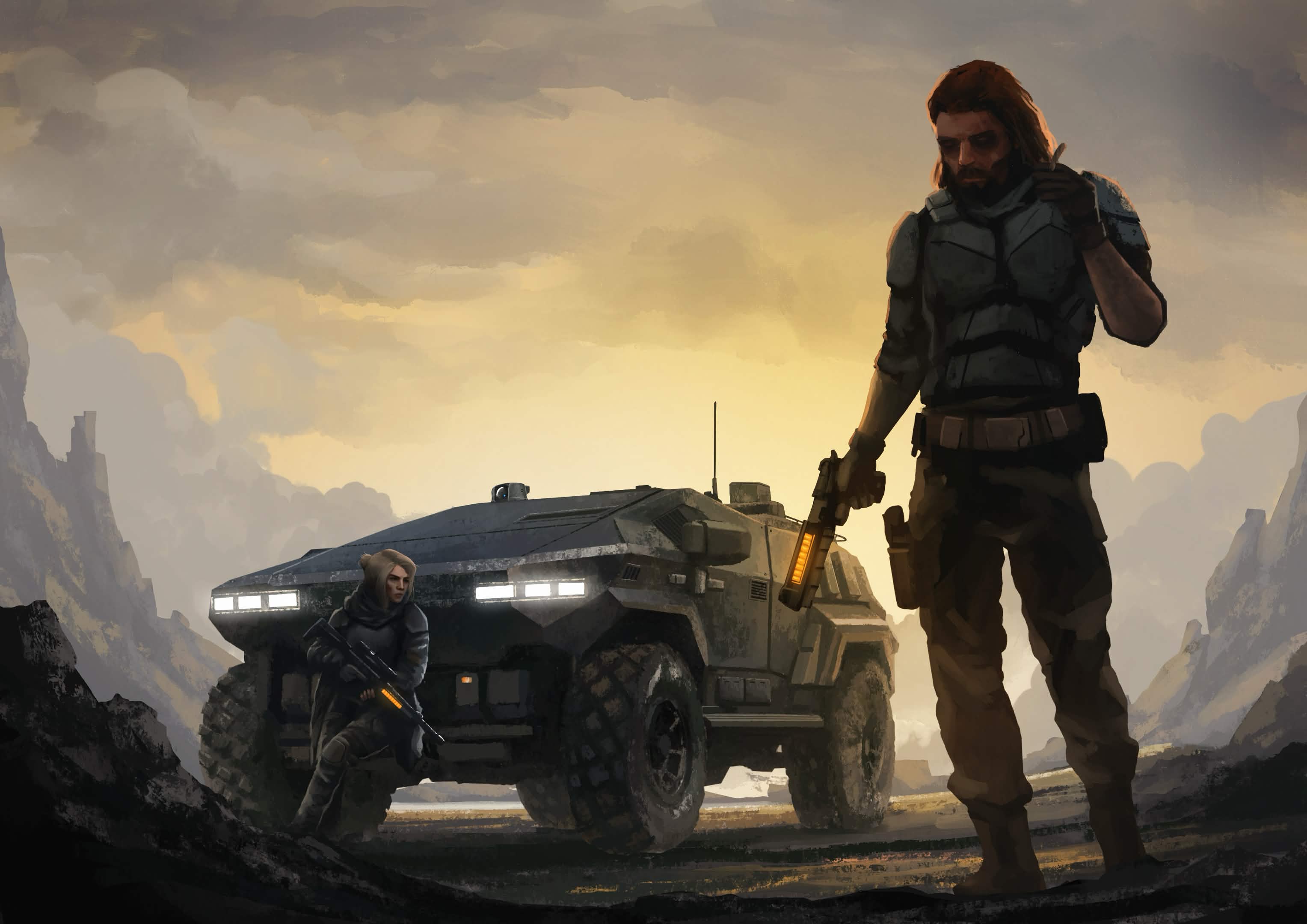
Vaer'gidon
The Firstborn
Firstborn
Vaer'gidon was the firstborn child of Emperor Vaer'karesh and the son who inherited nearly everything from his father except the desire to rule. He possessed the emperor's strategic brilliance, his instinct for warfare, his ability to read battlefields and enemies with equal precision, and his capacity for decisive action that inspired absolute loyalty in the people who served under him. What he did not possess was any interest in politics, governance, or the throne itself.
This absence wounded Vaer'karesh deeply. The emperor had built an empire through will and intelligence, and his eldest son carried both in abundance. Gidon stood where his father did not: tall, broad, physically imposing in ways no imperial-born child had been before him. His frame matched that of the Ngorrhali mountain warriors rather than the lean figures of the origin continent. He commanded attention simply by entering a room, and soldiers who had never met him would follow him into any battle. He looked like an emperor and thought like one, and he wanted none of it.
Frontier
Gidon's ambitions pointed only outward. He cared for conquest, for the expansion of borders, for the challenge of lands beyond the empire's current reach. Court politics bored him. He viewed succession as a burden and made no effort to conceal his disinterest. His father watched his most capable heir dismiss the very thing Vaer'karesh had spent his life building, and the rejection cut deeper than any assassination attempt ever had.
His most significant campaign took him westward into the hostile continent of Ukhaalstaag alongside the early Ngorrhali warriors who would later be formally recognized as Frost Sentinels. He brought members of the Solarn family to identify suitable locations for relay construction, pushing imperial infrastructure into territory no Geban force had successfully held. The Frost Sentinels favored him for his ethics and temperament. He led with straightforward clarity and no political maneuvering, which made him easy to follow, and because he was built like them, towering and broad where other imperials were lean, their loyalty to him came to resemble kinship.
Brother and Father
Like his father, Gidon proved prolific, fathering nearly as many children as the emperor himself and spreading his bloodline across frontier outposts and the capital alike. Unlike his father, he showed no concern for which of them might inherit anything beyond his name.
What Gidon did care for was his youngest brother. Vaer'maor was everything Gidon was not: gentle, diplomatic, politically minded. The firstborn took it upon himself to protect what he recognized as genuinely good in a family defined by ambition. He mentored Maor in confidence and left warfare aside, teaching the younger prince that softness could be a strength and that there were many ways to serve an empire beyond commanding its armies. The soldiers who loved Gidon learned to respect Maor through association, which was perhaps the most political act Gidon ever committed, and he did it without recognizing it as such.
When their sister Vaer'yinda began her campaigns in the eastern wilds, Gidon provided strategic counsel but declined direct command. The purging had no enemy to outmaneuver and no army to break, and he did not count it as warfare. Yinda did not need his talents for extermination. He continued his work along the empire's outer frontiers, pushing boundaries that would not be formally claimed for generations.
Death with Bregun
Gidon died in a frontier skirmish against Ukhaal Walkers alongside Frost Sentinel War Chief Tharyn'Bregun during their bonding trials, shortly after his father's death from old age. He commanded from the front until the end. He never ruled, never wanted to, and never understood why his father had considered that a tragedy. The soldiers who carried his body back to the capital mourned him as the greatest commander they had ever known. The Frost Sentinels who fought beside him mourned the loss of the only imperial who had ever truly been one of them. Their shared death during the bonding trials made an already solid alliance permanent, and the centuries since have not weakened it.