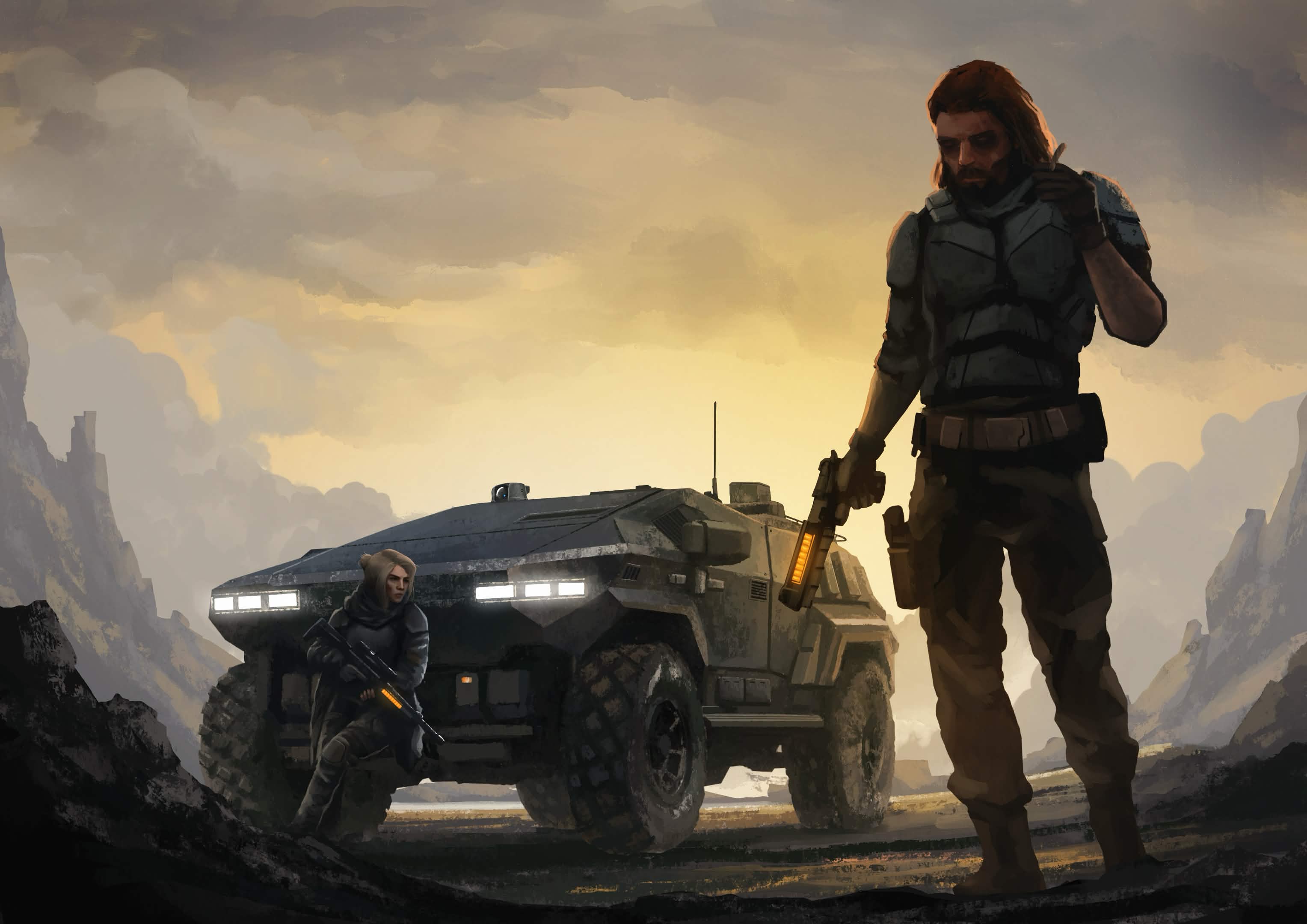
Varethis'Daer Venar
The Hidden Architect
Prince Varethis'Daer Venar was the younger brother of Emperor Varethis'Auren Kel'varesh and the originator of the Engineered. He stood at 5'6" and possessed the most extraordinary mind the natural-born population of Geba has produced in six thousand years of recorded history, a fact that was evident long before the Velcrith merge amplified it beyond parametric measurement. His current status is unknown. Velcrith Vessels live unnaturally long lives spanning centuries and potentially approaching millennia if not cut short by violent external intervention, which means he could still be alive somewhere on the planet or he could have died at any point in the millennia since his disappearance.
Before the Merge
Daer's output before the Velcrith merge was already beyond what any single individual had produced in the history of Geban science and engineering. He stabilized organ transfer protocols before he was old enough to sign his own work. He designed shock mitigation systems that functioned under open fire without sedation. His wound mesh was biological, with no alloys and no grafts, built from lattice-stabilized tissue designed to regenerate in alignment with host blood. He solved triage systems under siege in collapsing cities, where the work had to function or people died. Half the continent-grade clinics on the planet ran equipment he engineered before his second decade. He dropped the cost of medtech across almost every continent except the ones that remained unreachable because the land itself rejected logistics.
His fertility work made twin and triplet births viable again through pure biological refinement, lowering rejection rates and reducing maternal strain without synthetic intervention. This contributed to the demographic recovery, though the recovery itself began long before him. Emperor Ashan'Vaer Kel'varenath's Insemination Edict had stabilized the line when the birth ratio was nearly lost, and Daer built on that foundation.
Auren
Daer and Auren were the eldest of their siblings, and before the younger ones were born it was only the two of them. Auren exhibited extreme emotional and social intelligence from boyhood, treating merchants the same way he treated dignitaries, speaking to guards the way he spoke to engineers, giving no one more of his attention than anyone else while somehow ensuring none of them felt slighted by it. It was obvious from the time they were children that Auren would be selected to inherit and that Daer would be the one who supported him in being successful. This was never stated because it did not need to be.
Their father, Emperor Ashan'Kael Varethis, lived longer than most emperors before him through early longevity treatments, and rather than wait to die he abdicated to Auren while he still had the clarity to manage the transition, understanding that succession during decline produces instability. He once took both sons to the Kelan coast to observe the Northern Sea Phantoms and told Auren that when it was his time he would need to remember that the people would be like the phantoms waiting beneath the ships, patient and watching for a slip they disliked enough to justify attack. Then he looked at Daer and told him not to allow his older brother to fall into the water in the first place, that he would have to think ahead of what was beneath the surface and see the patterns before they completed.
Auren had shielded Daer even as young boys, recognizing what his brother was before anyone else did and ensuring he had space to think without interruption. He never made Daer feel strange for the way his mind worked. He simply made room for it. Auren was a devoted student of Prince Ashan'Raeth Vareth's writings, modeling himself after Raeth in most ways and studying everything Raeth had ever recorded, which is how he recognized the signs of the Velcrith merge when they began to manifest in Daer and was able to protect his brother's isolation during the process.
Velcrith Merge
The Velcrith resonance began as subsonic harmonic interference that Daer initially attributed to overwork and neurochemical fatigue, assuming that madness was the inevitable consequence of sustained polymathic cognitive load. The whispers resolved into structure instead of language: geometric, recursive, self-referential pattern systems encoding information at densities beyond what phonemic transmission could carry. The Velcrith resonate, propagating meaning through sympathetic oscillation in neural substrate; they have no speech and no sequential symbolic code. The transition from noise to signal required months and the transition from signal to integration required years, but Daer never stopped working through any of it because the work was the only architecture that held.
The merge amplified his precognitive heuristic processing until he could feel the shape of probability envelopes and the topological distortions that indicated convergent threat. He could taste conspiracy through proximity. He described the biochemical signature of betrayal as metallic and sulfuric, metabolized through proximity stress response. He discovered that all Velcrith Vessels could perceive through each other across temporal boundaries, even those who no longer existed, and through the resonance architecture connecting him to Prince Nethel he was able to observe Emperor Venar'Tal Kareth across the centuries that separated their positions in sequential causality, and he wrote privately of his inability to comprehend how someone could carry the cognitive burden of annihilation at that scale without psychological disintegration.
Making the Engineered
Daer conceived the Engineered as the sovereign continuation of humanity into places natural biology had failed to reach after three thousand years of imperial expansion: stratospheric peaks where pressure distorted perception, subterranean passages where undocumented organisms erased exploratory trails within hours, and glacial valleys where Ngorrhali ice bears claimed territories larger than provinces. Soldiering was never their purpose. He used Frost Sentinel DNA as the genetic foundation and brought viable subjects to term through sealed stasis matrices beneath the secondary vault.
The Assault-Class was designed for territorial dominance, with females carrying multiple gestation of up to eight individuals per slightly longer term, the drive to reproduce embedded without hormonal distortion so that replication followed alignment with environment rather than compulsive appetite. He noted impulse control issues in the Assault-Class males and watched the adolescents closely, fearing the trait could backfire on reproductive urge. He observed variance within the Assault lineage where some individuals were smaller than their siblings but far stronger mentally, children who never stopped solving problems and never tired of questions, whose bodies did not match the template but whose minds outpaced it. He watched them from infancy through adolescence and wrote that they were not soldiers. These would later be formalized as the Tactician-Class.
The Scout-Class was built for terrain surveillance independent of failing equipment, capable of perceiving across extended spectrums. The first Scout toddler appeared strange, and Daer acknowledged that this could not be avoided given the adaptations. He noted that when the child stared into what looked like emptiness he was staring at everything, and he planned to take him to the countryside because the boy had never seen the sky. He struggled with Scout-Class female reproduction, acknowledging that their adaptations resisted natural replication through mechanisms he had not yet identified.
The Destroyer-Class was created from Daer's deepening awareness that the court was saturated with hostile intent directed at Auren. The Assault lineage was built for open territorial combat and was insufficient for protective interdiction against coordinated political assassination, the surgical elimination of threat networks operating within imperial infrastructure. The Destroyer-Class was overwhelming mass and psychological impossibility, designed so that if they could not be stopped they could not be circumvented and Auren would survive. He acknowledged privately that the design was not rational and that rationality was a subset of pattern recognition, and the pattern said act.
Txisa
Txisa Haavu-Solarn was his closest collaborator. Together they developed the Recursion Surveillance System, a real-time global mapping platform powered by infinite recursion energy principles integrated with experimental Solarn transmission systems, designed to identify threat networks before they could crystallize into actionable conspiracy. They completed the first Recursion Bomb prototypes in western Ngorrhal. The surveillance system would later form the foundation of Imperia Research.
Txisa accepted Daer before the merge and after it without distinction, which he noted in his private journals as rare and valuable. He recognized her attachment through physiological indicators when they worked together and recorded that he felt affection and gratitude toward her, but that the Velcrith resonance had altered his capacity for attachment along conventional relational axes and he could not return what she felt. He did not know how to tell her this without damaging something he could not afford to damage. He wrote about taking her to Jeyrha for the harvest festivals in Reykhaal, about wanting to see her enjoy something that was not work, and about wanting to enjoy something that was not work himself. He did not have time.
Kaelera
His sister Varethis'Kaelera Gevurah believed herself equal to Auren and to Daer, and Daer acknowledged that she was right in the categorical sense of bloodline equivalence, succession proximity, and cognitive capacity within acceptable variance. What concerned him was that her ambition was oriented toward equivalence rather than function, and that the desire to carry weight was itself the vulnerability. He wrote that she did not conspire, that he would have sensed it through the resonance architecture, and that she loved them and meant well. He also wrote that what would hurt her was the configuration of forces her positioning invited, and that he could not protect her from geometric inevitability.
She was doing her best to be useful in a configuration where usefulness was a nearly impossible task when measured against what her brothers were accomplishing, but she was managing it. When Auren was assassinated Daer sent her seven transmissions urging her to leave the capital. She never responded. She would not leave. She was killed during her first public appearance as Empress.
Auren's Death
Daer felt Auren's death through the Velcrith resonance before the reports arrived. The pattern collapsed. He had built everything to prevent it: the surveillance system, the Destroyer-Class, years of anticipation and preparation. Auren was still dead.
He provided the Engineered with intelligence from the surveillance system identifying every conspirator, every family, every lineage involved. The Engineered remembered who had freed them. The purge took moments. Entire bloodlines were erased. Daer watched through the system and did not look away.
He ordered Auren's wives and children escorted to Kela. The Engineered volunteered without being asked. Among the volunteers was the Scout-Class he had taken to the countryside as a boy, who arrived with tears in his eyes. He did not tell Txisa he was leaving, writing that she would follow him and that she would die following him. He arranged for the Haavu family to take her to Jeyrha, the place he had once imagined bringing her himself. He wrote that she had a future there and that she did not have a future with him because he did not have a future.
He vanished without claiming the throne, comparing himself to the Ngorrhal Windbrace, a plant that grows where nothing else survives and purges poison through convulsion. He wrote that he was the toxin now, that the Empire would convulse and purge him or die, and that the Engineered would continue because they were alive and more human than the rest of them. He said that he gave them life and Auren gave them freedom, and that it was not nothing, and that it was not enough.
Legacy
Hundreds of Engineered were produced before his disappearance through the laboratories that would later become Imperia Research, and from those hundreds thousands were born naturally, and from those thousands even more hybrids followed. The Empire absorbed them faster than Daer could document, distributing entire cohorts across military and industrial infrastructure before individuation assessment could be completed. He wrote that they were living lives he did not design, making choices he could not predict, forming attachments and conflicts and purposes that had nothing to do with him, and that this was correct because it was what survival meant. They were the continuation of the species into places it was never built to reach.
He found solace in Abyssal Harmony, attending performances anonymous and hooded, another figure in the congregation oriented toward a shared mystery none of them could name. The music operated on frequencies that interfaced with the Velcrith architecture without overwhelming it, inducing states of cognitive suspension that permitted background integration without active interference. The performers wore masks depicting what they believed the Velcrith and Seraveth looked like, and they were wrong, but the intention produced something and the sound produced something, and he wrote that it was the only place he felt proximity to normal.
Fragments of his private journals were purchased millennia later by Yelidra Veykar. His current status remains unknown.