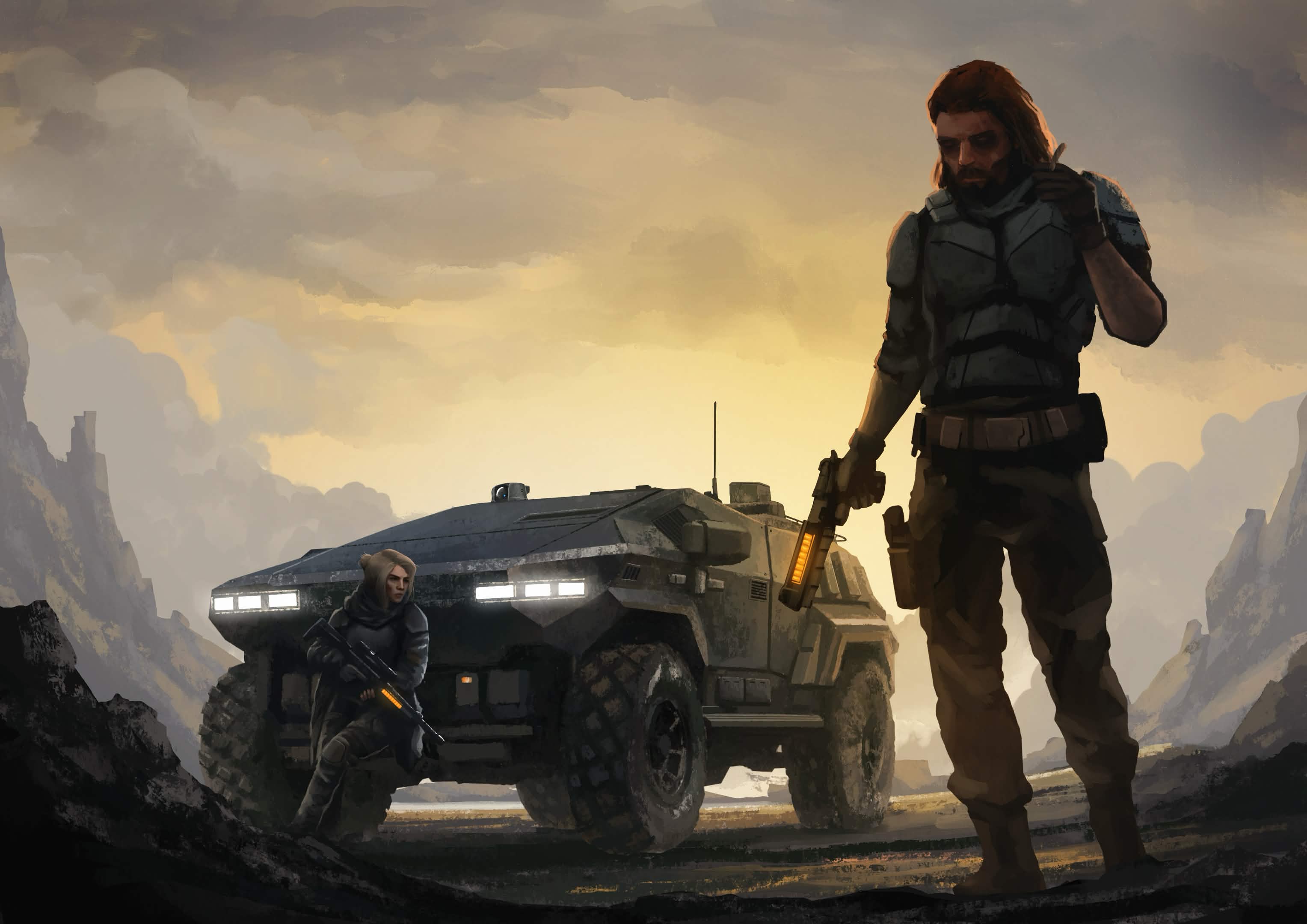
Varen'Kayeb Kal'vashir
The Strong Farmer
Varen'Kayeb Kal'vashir was born on a remote, sovereign farmstead in southwest Geba, land his father had cleared of warlords and later claimed for himself, a veteran Shadow Operative whose silent service spanned nearly a century. The farmstead sat far from everything but close enough to the capital for relay connectivity and travel. His father had seven wives who sought refuge there. Kayeb was raised among them alongside two half-brothers. He is registered as a Tier 1 contractor.
The alias Caleb is a corruption of his given name Kayeb. Said fast or casually, Kayeb sounds like Caleb, and the shortened form stuck. When he entered deep cover operations during the Warlord Eras, it became his operational identity: a name close enough to his real one that he would respond to it naturally, but different enough on paper to keep his actual record clean. It is the name most people know him by.
Farmstead and Brothers
The farmstead functioned as both a working agricultural operation and a place deliberately removed from the wars consuming the rest of the planet. Kayeb and his two half-brothers were raised there in quiet labor. Their daily life involved managing Lichengrazer herds and defending them from Lesser Smilohounds that regularly attempted to take livestock. For boys growing up in isolation, this was the extent of the danger they knew.
One of the brothers could not accept it. He understood that the farmstead was hiding them away from the Warlord Eras, and he wanted nothing more than to fight something larger than the Smilohounds raiding their herds. He ran away from the farmstead. What became of him is not recorded in any system Kayeb has access to.
The other brother remained. He would later become the father of Varen'Samyl Venar. Samyl is unaware of his father's identity and does not know that Kayeb is his uncle.
Training and Recruitment
Kayeb's father trained him without knowing he was doing it. The routines of the farmstead were the methods of a Shadow Operative applied to agricultural life: planting under pressure, moving without sound, breathing through sustained physical hardship, and reading terrain and weather for tactical advantage. After his father's death and his mothers' departure, operators arrived at the farmstead. They recognized the inherited posture and movement patterns as the mark of a lineage that had been prepared for recruitment without ever being told.
Service
Kayeb served across the fractured landscape of the Warlord Eras as a deep cover operative embedded in warlord factions, remnant imperial structures, and dying regimes. His work consisted of surveillance, infiltration, and erasure without trace. He operated under fractured banners, taking assignments from the Shadow Rule structure that continued to function beneath the chaos of the Warlord period. His tier classification places him at the highest level of the Solarn Contractor Registry, a designation that does not appear in the public system and is maintained through Imperia Research.
During a failed extraction, Kayeb was wounded and found shelter with Naira Siran, a civilian survivor living alone on the edge of Thazahd, a contested grey-zone city, near a forgotten trade route. Their encounter was brief and need-driven. He departed at dawn and never learned that the night produced a child. That child was Zairen Vaul, who would go on to found the Church of the Infinite Maw. Kayeb remains unaware of his son.
Retirement
After the Warlord Eras ended and the Shadow Rulers restored order, Kayeb returned to the overgrown farmstead and reclaimed it. Other veterans, Engineered with no remaining purpose, and former operatives gradually joined him. The farmstead grew into a full-sized clearing with its own small relay tower for minimal connectivity, while retaining its original name, Kal'vashir's Farmstead.
Kayeb repurposed a war-drone to document and broadcast feats of physical endurance from the farmstead: labor, building, land clearing, and sustained exertion performed without audience or competition. The broadcasts filled the silence left by the end of the wars and drew viewers who found in the work something about carrying on after everything had stopped. He is known to most of the planet as Caleb the Strong Farmer. Very few people alive know what the name Kal'vashir actually represents.